Why the City isn’t buying a ‘time-limited’ bank tax hike


John Healey may have opened Pandora’s Box with an increase to the UK bank surcharge. Samuel Norman looks at whether he will resist the temptation to extend it.
Few things in British politics have proved to be as permanent as a “temporary” tax.
When the Conservatives introduced the 25 per cent energy profits levy in 2022, it came with a strict December 2025 sunset clause. Six months later, the deadline slipped to 2028. By 2024, under a Labour government, it was extended to 2030 and hiked to 35 per cent.
The old Whitehall trick even applies to income tax, which itself arrived in 1842 as an emergency three-year measure, yet survives nearly two centuries later on rolling annual renewals.
It is little wonder that the City has already switched into defensive mode after Chancellor John Healey’s “time-limited” hike to the banking surcharge.
While the Budget document insisted there would be legislation for the time-limited period and it would “not be extended,” it has done little to reassure the sector.
“We hope this tax rise is limited,” William Chalmers, finance boss of Lloyds Banking Group, said.
He added the measure would be “unhelpful” for the government’s growth ambitions.
Writing in City AM, UK Finance chief David Postings said: “History gives us reason to be cautious. Taxes introduced in response to temporary pressures have a habit of lasting longer than originally intended”.
He added the government should look to reduce the burden over the long term and not increase it.
“This is not an abstract concern. International firms decide where to deploy capital and create jobs. A stable and predictable tax regime is one important factor in those decisions.”
Banks ‘disappointed’ by tax hike
The increase amounts to a £1.5bn tax grab and will take surcharge receipts to £2.4bn for the 2027-2028 period. This will be up from £1.2bn in the last year.
Natwest, Nationwide and Lloyds are set to be the most exposed to the surcharge increase, according to RBC analysis. Meanwhile Jefferies estimates the surcharge costs around 0.5 per cent of market value, due to the temporary basis.
“If this is genuinely 15-month time-limited, the capital impact at around 0.5 per cent of market value is more relevant,” Jonathan Pierce, analysts at Jefferies, said.
“Granted, investors may not believe this is the case.”
RBC’s Benjamin Toms added “The market will be sceptical that these changes will be temporary based on experiences elsewhere in Europe such as Spain,”
Spain introduced a 4.8 per cent levy on banks’ net interest income and fee revenues for 2023 and 2024, raising highs of €1.7bn. The nation’s government would go on to extend this to 2027 and replace the flat rate with a sliding scale tied to revenue earned.
Healey’s changes will give rise to caution for bank investors, who have trodden this path before. But ahead of the Budget the UK’s outsized tax rate for lenders already stood out – as one banking source irately pointed out, the increase marked an “extra tax on top of an extra tax”.
Another industry source said there was “disappointment” following the tax hike, even if many had “come into the day thinking it could have been worse”.
John Duncan Edwards, chief executive of transatlantic trade body British American Business, said: “It is surely an act of self-harm to target a sector at which the UK excels.”
Time limits taken with ‘pinch of salt’
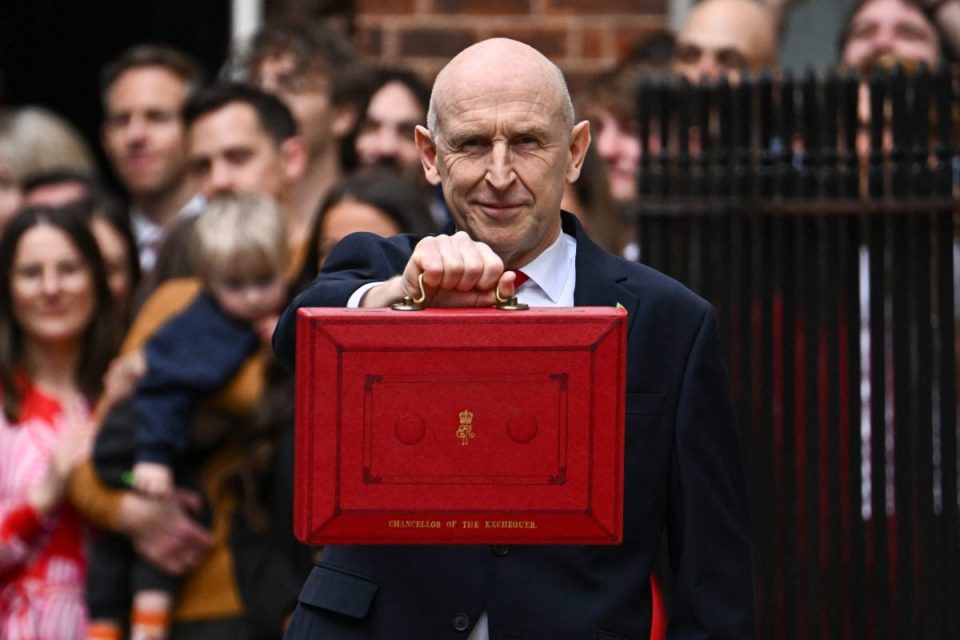
Healey framed the move as helping to fund an energy support package, including the flagship policy of paying £100 to 20m households to help with bills this winter following the surge in prices from the US-Iran war.
“I don’t see an obvious linkage between energy prices and bank taxes,” Chalmers said.
Will Howlett, financials analyst at Quilter Cheviot, pointed to the energy windfall tax continuing in operation today, adding “banks will be very wary of this”.
“This time limit should be taken with a pinch of salt,” he added.
“The geopolitical situation shows no sign of abating… there will need to be a material change to the conflict in the Middle East for the better in order for the government to feel they can return to the previous levels.”
Banks had been on the backfoot ahead of the Budget after rumours of a windfall tax ran rampant. Many were bracing for a reversal of Jeremy Hunt’s 2023 bank tax cut, taking the surcharge back to eight per cent.
But the Trade Union Congress suggested the surcharge could be raised to a 16 per cent in order to capitalise on the booming half-year profits of top lenders.
That paved the way for some positive share movement when it was announced the surcharge would move to six per cent for just a temporary period. But stocks moderated through the session and finished only moderately up, when compared to the highs reached in the aftermath of Healey’s announcement.
“A ‘do no harm’ Budget was our test. It is one that the Chancellor has not quite met,” Miles Celic, chief executive of TheCityUK, told City AM, diplomatically.
“[The bank tax’s] temporary nature matters, but only if the Chancellor honours his commitment to removing the increase after 15 months.”