The McDonald’s doctrine is dead: Ukraine shows why

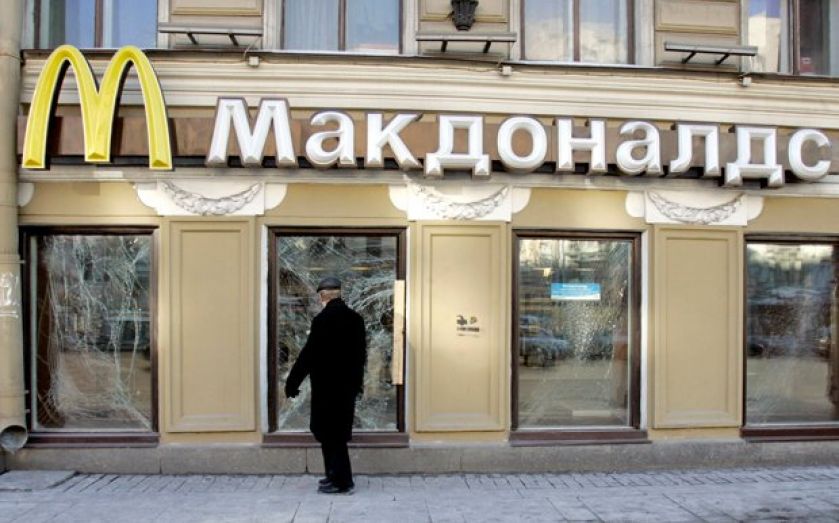
A GREAT event took place in Pushkin Square, Moscow on 31 January 1990: a branch of McDonald’s was opened. There was similar excitement in Kiev on 24 May 1997, when the McDonald’s franchise was extended to Ukraine. The US author Thomas Friedman wrote in 1999 that no two countries with such a franchise had ever gone to war with each other. It was a striking and imaginative idea, which rapidly became part of the received wisdom of the chattering classes. If economic prosperity could spread more widely across the world, liberalism and tolerance would follow.
This relationship remained fairly accurate until dramatically overturned, first, by the war between Georgia and Russia in 2008, and subsequently by events in Ukraine. Semantic quibbles aside, a state of war exists between Russia and Ukraine. It shows the dangers of relying on relationships which seemed valid in the past to try and predict the future – especially with no understanding of the underlying reasons why a relationship might have existed.
Friedman was aware of this problem. In his 2005 book The World is Flat, he developed the McDonald’s observation into his Dell Theory of Conflict Prevention. He proclaimed that “the Dell Theory stipulates: no two countries that are both part of a major global supply chain, like Dell’s, will ever fight a war against each other as long as they are both part of the same global supply chain.” He reasoned that countries do not just want to be better off, but they want part of the action of globalisation for themselves. They want multinationals to locate part of the global supply chain within their own countries, rather than just sell them things. If they go to war, large foreign companies are unlikely to want to base part of their operations there.
The trouble with this view is that, for many people, the possibility of dramatic change (inherent to globalisation) is very scary. If embraced, the past is no longer a reasonable guide to the future. An alternative – which may eventually prove to be very much superior – can be rejected in favour of the old familiar routines. Russia and Ukraine are victims of this attitude. Neither country has really embraced Western market-oriented economic structures since the fall of the Berlin Wall. Bits of them have – one explanation for the tension between the western and eastern parts of Ukraine. But overall, many prefer what they know to what they could be.
The costs have been huge. In Poland, income per head is now more than double what it was in 1990. In Ukraine, it has now just about struggled back to the level of 1990. Two decades with virtually no overall growth! Yet many people in Ukraine seem to prefer this outcome, with its security blanket, to the much more frightening world which the Poles embraced successfully.
A longstanding assumption in Western views of international relations is that economic growth will encourage the spread of liberal values. Events in Ukraine show that many people may not even want the prosperity, if it means they have to embrace uncertainty.
Paul Ormerod is an economist at Volterra Partners, a visiting professor at the UCL Centre for Decision Making Uncertainty, and author of Why Most Things Fail: Evolution, Extinction and Economics.