Manchester United’s new stadium could be delayed until 2035 as timeline slips

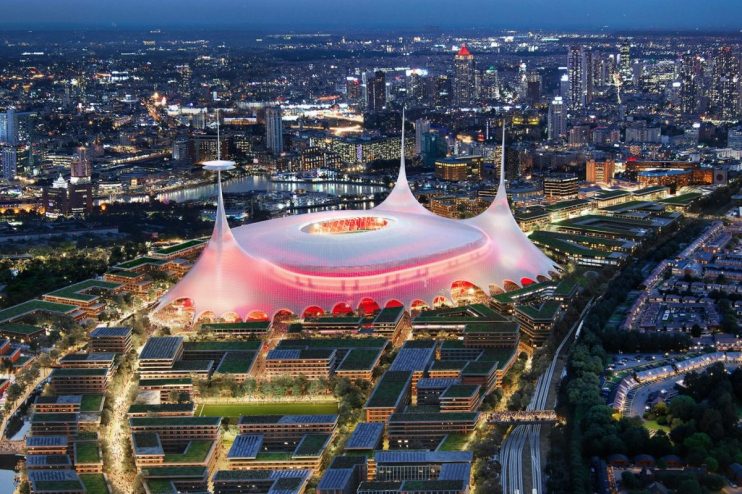
Manchester United’s new stadium may not open until 2035, according to official planning documentation.
The timeline for the £2bn-plus project has repeatedly slipped ever since minority owner Sir Jim Ratcliffe announced in March 2025 that United would build a new stadium rather than renovate Old Trafford. At the time, the billionaire said it could be completed in five years, joking: “I’d rather spend five years than 10 years. I might not be here in 10 years!” He may, in fact, have to wait that long.
Stories later emerged that it would be ready by 2030. Then a potential ribbon-cutting was put closer to 2032 by Collette Roche, chief executive of United’s New Stadium Development, when she discussed the project in the summer. But official documentation suggests fans may not set foot inside the proposed 100,000-seater venue until 2035.
The Trafford Wharfside Strategic Masterplan Consultation Draft, produced by Trafford Council, omits the new Manchester United stadium from phase one of delivery – running from 2025 to 2030. Instead, the stadium is slated for phase two, in a window from 2031 to 2035.
The club hope the venue will host the 2035 Women’s World Cup final, due to be held in the UK, but face a race to meet that deadline amid significant hurdles – not least securing funding.
Otro Capital now free to sell Alpine stake
Rory McIlroy, Trent Alexander-Arnold and Anthony Joshua are now free to cash in on their stake in the Alpine F1 team after a three-year restriction expired.
When Otro Capital – whose backers include several major sports stars – bought a 24 per cent stake in the Renault-owned Formula 1 team in 2023 for £173.2m, a clause in the agreement stipulated the investors could only sell within three years with prior approval. Documents seen by City AM confirm the restriction has now been lifted, clearing the way for a sale.
Otro Capital has held talks with multiple interested parties and, with F1 team valuations booming, are seeking a three-fold return. Whether they achieve that remains to be seen.
Mercedes pulled out of negotiations in May, concluding that the £606.3m valuation was too high. A consortium linked to former Red Bull principal Christian Horner is also understood to be interested.
Burnley’s ditched sponsor’s fake reviews
Football clubs have long been susceptible to dubious sponsorship deals in pursuit of ever more revenue. Manchester City famously ended a partnership with 3Key, a cryptocurrency start-up, after it emerged company executives might not exist.
So eyebrows were raised when Burnley ditched front-of-shirt sponsors Finotive One after only 42 days. The brand appeared on shirts during a preseason US tour before suspicions grew and the club started erasing links to the self-described “integrated trading ecosystem”, including a glossy promotional video featuring Arnold Schwarzenegger.
A cursory Google search before signing the deal might have spared them the headache. One of the top results is the Trustpilot rating for Finotive Funding – the company’s trading platform.
At least, it would’ve had a rating if it had not been removed due to breaching guidelines after Trustpilot deleted “a number of fake reviews”. Almost a third of the remaining reviews are one-star, with users complaining about profit splits and warning of difficulties withdrawing earnings.
Unpicking the deal will be costly. The logo had already been printed on men’s, women’s, and academy shirts, as well as training gear. Fans who had already bought jerseys were offered full refunds.
Finotive One did not respond to a request for comment.
A new take on Rangers administration
The man who plunged Rangers into administration in 2012 is now offering advice on “Deep Value Investing” and “Bullet Proof Asset Protection” on his personal website – which includes a fascinating take on his time at the Scottish club.
Craig Whyte describes being placed “in the center of a media storm” while at Rangers, an experience that “didn’t break him; it sharpened him”.
That is certainly one way of looking at it. Another is that he used money from the sale of future season ticket income – £20m from Ticketus in return for three seasons of ticket revenue – to buy the club in 2011, and a year later Rangers were placed into administration owing around £9m to HMRC. The administrator later said there was “widespread concern” about the Ticketus arrangement.
Whyte was acquitted of fraud in relation to the takeover following a seven-week trial at the High Court in 2017.
Slow and steady wins the race
While multiple parties attempt – and in Michael Johnson’s case, spectacularly fail – to drag athletics into the mainstream outside Olympic years, the steadily successful Diamond League is preparing its next stage of growth.
A deal has been struck with sports and entertainment marketing agency Two Circles, whose clients include the International Olympic Committee, Premier League and Uefa, to lead a new content and commercial strategy. Storytelling and digital fan engagement sit at the heart of a plan, due to roll out for the start of the new season next May, to entice new and younger audiences.
While Johnson’s Grand Slam Track burst onto the scene – faster even than Johnson in his prime – promising mega prize money before quickly collapsing, the Diamond League, established in 2010, continues to grow diligently.