Think EVs are dull? The Peugeot E-208 GTI will change your mind

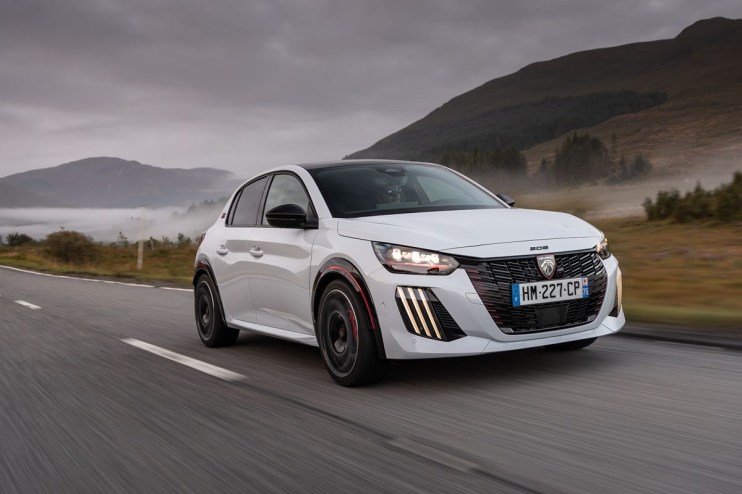
Tim Pitt drives the new electric Peugeot E-208 GTI hot hatch. Can it rekindle the spirit of the classic 205 GTI?
Europe’s car companies are increasingly looking backwards to move forwards. Retro styling, which began as a bit of a gimmick with the Volkswagen New Beetle in 1998, is now melded into the mainstream.
Take Renault with its reborn Twingo, 4 and 5. Or Fiat, which has reimagined the classic 500, Panda and Topolino. Even BMW, lately a champion of avant-garde and divisive design, now finds inspiration in its 1960s ‘Neue Klasse’.
Why the shift in strategy? The huge influx of Chinese vehicles, which made up 15 percent of all UK new car registrations in the first half of 2026, is surely a factor. The likes of BYD, MG and Jaecoo might undercut the Europeans on price, but what they don’t have is heritage.
Peugeot can trace its roots back to 1896 – or a fair bit further if you include the bicycles and pepper grinders – but the most revered car in its recent history is the 205 GTI. Arguably the greatest hot hatchback of all time, it’s source code for Peugeot’s new retro reboot. Say bonjour to the E-208 GTI.
Escaping the 205’s shadow
A car journalist wittering on about the 205 GTI is a bit like a political pundit talking about Brexit. There is nothing left to say that hasn’t already been said. For the record, however, I owned a 205 1.6 GTI in my late teens and recently drove a 1.9 GTI restored by Auto Rara.
You can read my review of that concours-winning GTI here, but it concludes by awarding the Peugeot a full five stars and declaring it ‘a driver’s car of the highest order’. In other surprising news, the NHS won’t be getting that extra £350 million a week.
Laid to rest in 1994, the 205 has cast a long shadow ever since. Peugeot has had hits (106 GTI, 306-GTI-6) and misses (206 GTI, 207 GTI), but none has quite recaptured the magic of its original hot hatch. Does the first electric Peugeot GTI stand a fighting chance?
On paper, it has promise. A 54kWh battery (51kWh usable) sends 281hp to the front wheels via a Torsen mechanical limited-slip differential. You also get bigger Alcon brakes, hydraulic bump stops and premium Michelin Pilot Sport 4S tyres. A 0-62mph time of 5.5 seconds easily outsprints the rival Alpine A290 GTS (6.4sec) and Volkswagen ID. Polo GTI (6.8sec), while a starting price of £33,495 – after the £1,500 Electric Car Grant is deducted – looks tempting, too.
The only options of note are a panoramic sunroof (£500) and eco-oriented Hankook tyres (no cost), which extend the E-208’s official, WLTP-tested range from 219 to 233 miles. Okenite White (pictured here) is only free paint colour; all other hues – Elixir Red, Miramar Blue, Agueda Yellow, Nera Black, Cumulus Grey and Selenium Grey – will cost you between £750 and £950.
Go-faster stripes and a sorted stance
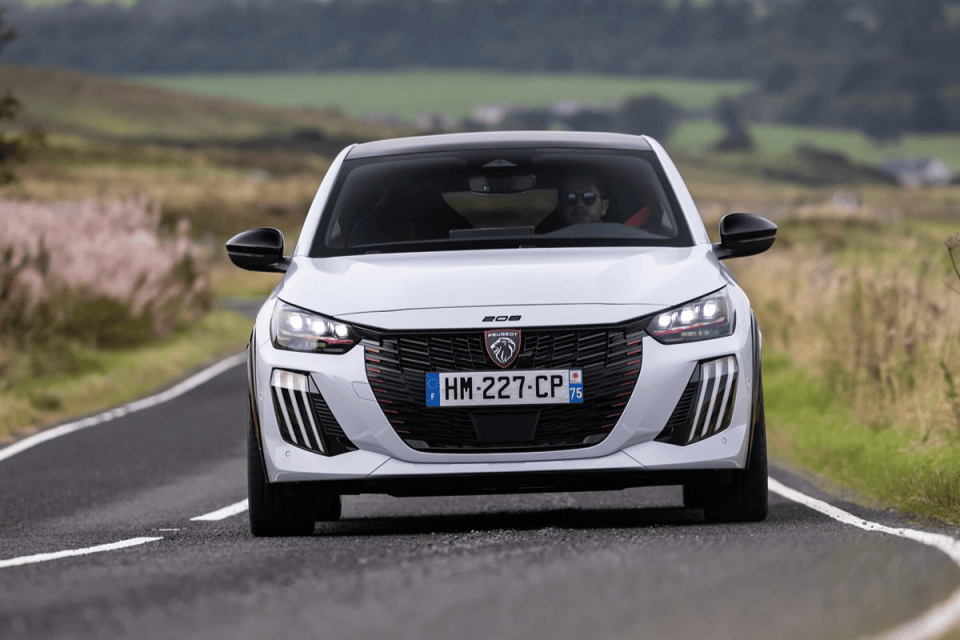
To Scotland, then, where Peugeot has taken over an entire hotel by Loch Lomond. The E-208 GTI is parked out front, next to a gleaming 205 – just in case anyone missed the memo. Seeing a classic car cheek by jowl with its modern ancestor usually makes the latter look enormous, but that isn’t the case here. The 208 is still pleasingly compact, without the lofty, crossover-style stance of the new Renault 5.
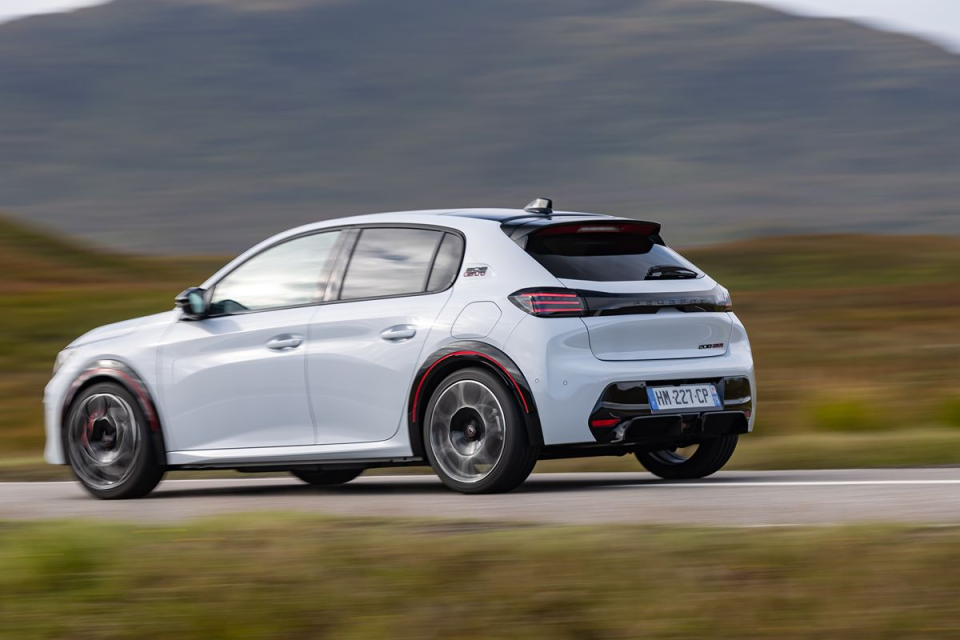
Speaking of stance, the 208 GTI gets it spot-on. With suspension lowered by 25mm and a wider track (56mm at the front, 28mm at the rear), its 18-inch alloy wheels – a homage to the gorgeous Speedline rims on the 1.9-litre 205 – fit snugly within the flared wheelarches.
Red go-faster stripes and model badges on the C-pillars are further nods to the deux-cent-cinq, while a gloss black splitter, roof spoiler and aerodynamic diffuser add some welcome hot hatch attitude. Like Peugeot GTIs of the past, though, it doesn’t look yobbish or aggressive. “We didn’t want the exterior design to be too overstated or to show off too much,” explained design director Matthias Hossann.
Inside the Peugeot E-208 GTI
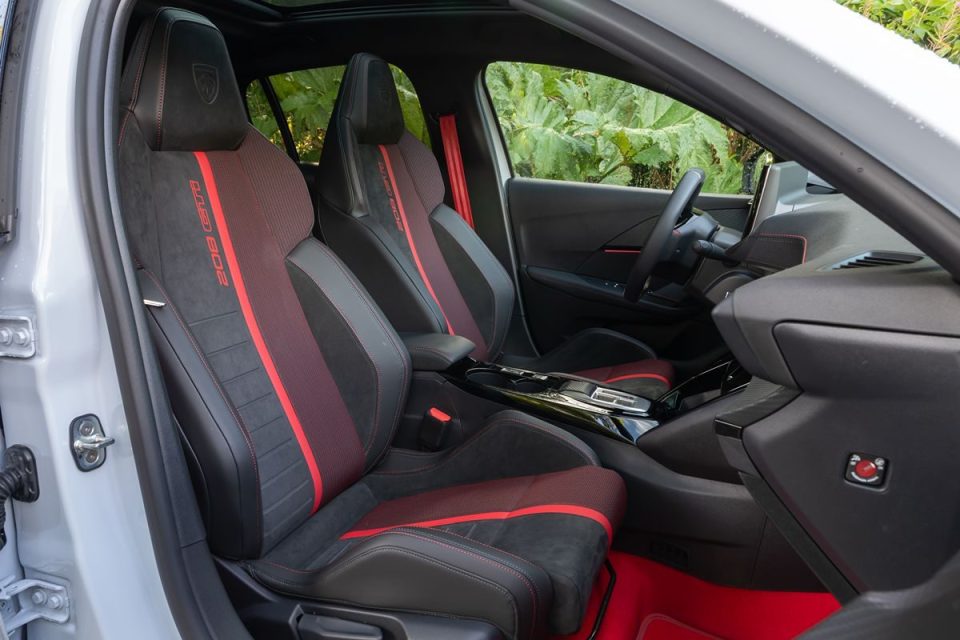
If the outside is quite subtle, the E-208 GTI’s interior turns up the visual volume. Like the aftermath of a chainsaw massacre, its scarlet carpets and floor mats are yet another throwback to you-know-what. I love Peugeot’s chutzpah – the only other car I’ve driven with red carpets was a Ferrari – although the fact we were given additional black mats “so it won’t look dirty in photos” suggests they aren’t particularly practical.
Elsewhere, there is more red on the seatbelts, upholstery and stitching, lest you forget you’re inside a hot hatchback. The GTI-specific front seats look great and feel supportive, while the squared-off steering wheel is trimmed in perforated leather and grippy Alcantara.
Unlike the three-door-only 205 GTI, all versions of the 208 have five doors, which makes climbing into the back a lot easier. Rear-seat space isn’t especially generous, although two adults can travel in comfort. The boot swallows a class-competitive 309 litres of luggage, which grows to 1,118 litres with the 60:40-split rear bench folded.
Hurry up and weight
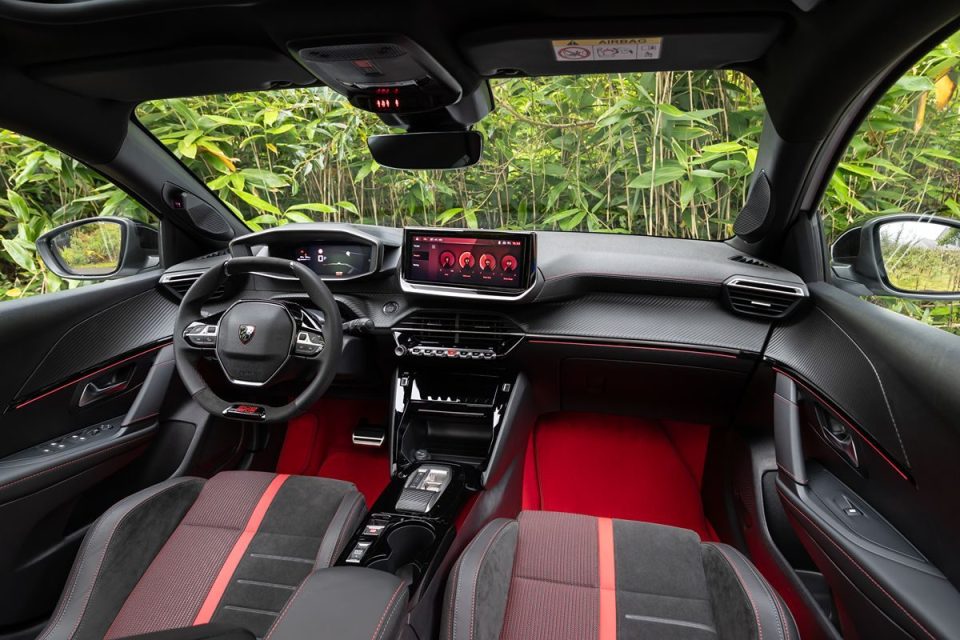
This second generation of 208 was originally launched in 2019, so the hot version arrives six years into its lifecycle. Indeed, it was never part of the plan until current Peugeot CEO Alain Favey took the reins in early 2025. To say the GTI has been fast-tracked is an understatement.
Inevitably, some aspects of the 208’s interior and tech are showing their age, but I won’t gripe about a modestly sized touchscreen and proper ‘piano key’ switches. I also like the 3D driver’s display and dedicated GTI performance readouts, such as a G-force meter and 0-62mph acceleration timer. Clearly, this car doesn’t take itself too seriously. You can switch off all the driver assistance (ADAS) systems with one long button-press, too. Parfait.
Interior quality is in a different league to a 205 GTI, although sadly so is the E-208’s kerb weight. It tips the scales at 1,535kg: some 81 percent heavier than its flimsy forebear (850kg in 1.6-litre guise, to save you doing the maths).
Taller folk may struggle with Peugeot’s trademark ‘i-Cockpit’ layout, which positions the instruments above an unusually small steering wheel, rather than you viewing them through it. It suits my 5ft 8in frame pretty well, though – and the go-kart-sized wheel seems more apt in a GTI than, say, a Peugeot 5008 MPV.
Peugeot E-208 GTI on the road
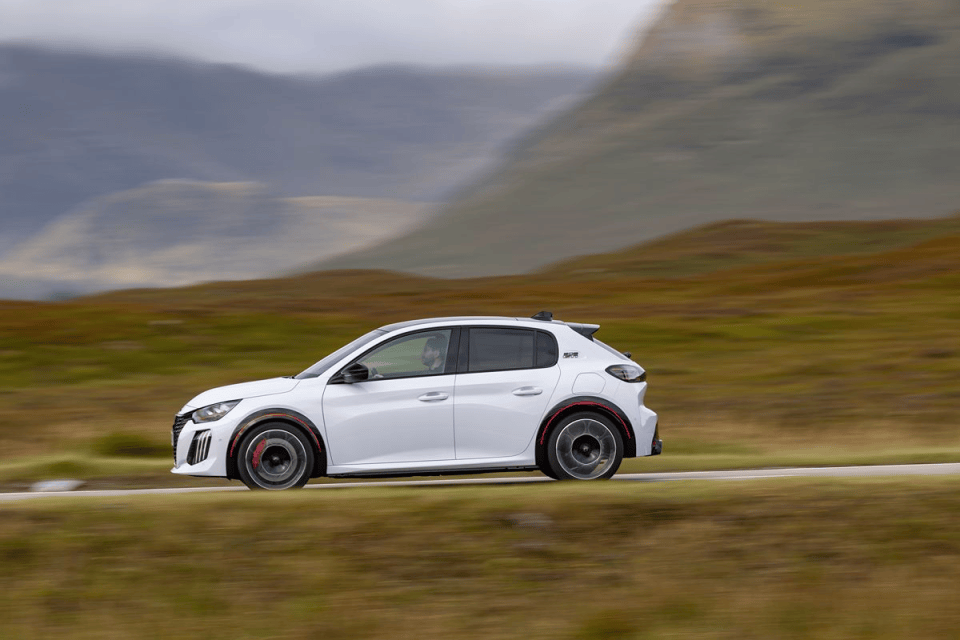
Before we even leave the hotel grounds, it’s clear this new GTI means business. Its damping feels rigorous, with a clenched-muscle quality that reminds me of the departed (and much-missed) Ford Fiesta ST. The ride is restless at low speeds around town, although never gets to the point of being crashy or uncouth. And the reward is excellent body control when you start to go faster.
I’d like a bit more detail through the steering – the 205 remains a benchmark in this regard – but chuck the 208 into a bend and it feels poised and precise. You sense the Torsen differential begin to bite, hauling you towards the apex then unwinding again as you blast away. Body-roll is minimal, the stock Michelins cling on tenaciously and traction feels assured. On sinuous and narrow Scottish lanes, you can cover ground at quite a rate.
Switching the Peugeot into Sport mode removes the energy regen function from the brakes, instantly improving the otherwise slightly mushy pedal feel. You can still leave the transmission in ‘B’ to benefit from motor braking, though – and eke out a few more miles of range. More on that shortly.
Influenced by the 9X8 Hypercar
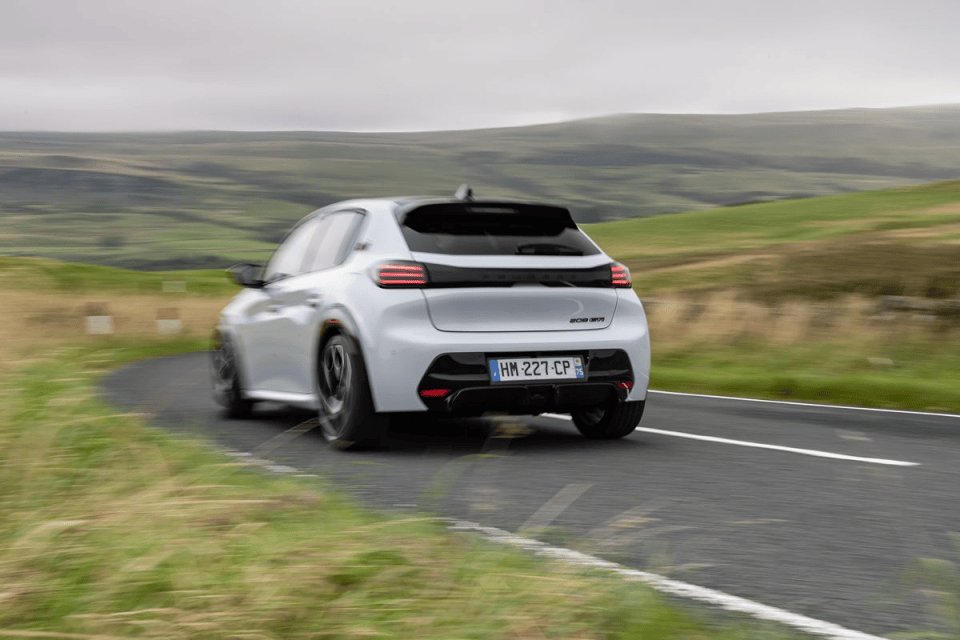
With a class-leading 281hp, plus 254lb of electric torque available from a standstill, the GTI also has enough ‘go-faster’ to earn its red stripes. Christophe Auriault, project manager at Peugeot Sport, says its influences include the 9X8 Le Mans Hypercar: “It draws directly on the know-how gained in motorsport and transfers it from the circuit to the road. The skills used for the development of E-208 GTI are the same ones that can be found when working on the 9X8.”
Peugeot is particularly proud of this powertrain’s thermal management, which allows it to lap the Nurburgring at maximum-attack without overheating. A synthetic soundtrack (half-internal combustion and half-jet engine, or so it seems) is pumped through the speakers in Sport mode. You can mute it, although I thought it added to the experience.
One thing Peugeot won’t offer is a virtual manual gearbox, as seen in the Hyundai Ioniq 5 N and new Kia EV4 GT. Arguably, this is another way to make EVs appeal to keen drivers, although judging by the comments on my social media, many enthusiasts consider it an artifice too far. Either way, the Peugeot feels engaging enough not to need it.
The downside to driving in a suitably ‘GTI’ manner is the dent it makes in battery range. ‘Making progress’ on rural Scottish roads, I saw a predicted range of around 150 miles. Other, more-lead-footed journalists were closer to 120 miles – almost half the official figure quoted by Peugeot. And while it’s true that a petrol-powered hot hatch would also be thirstier in such conditions, it only takes five minutes to fill up with fuel. Fully replenishing the E-208 GTI requires 4hr 40min using a typical 7.4kW home wallbox, while a maximum charging speed of 100kW potentially means a 20-80 percent fillup in 30 minutes using a public rapid charger.
Verdict: Peugeot E-208 GTI
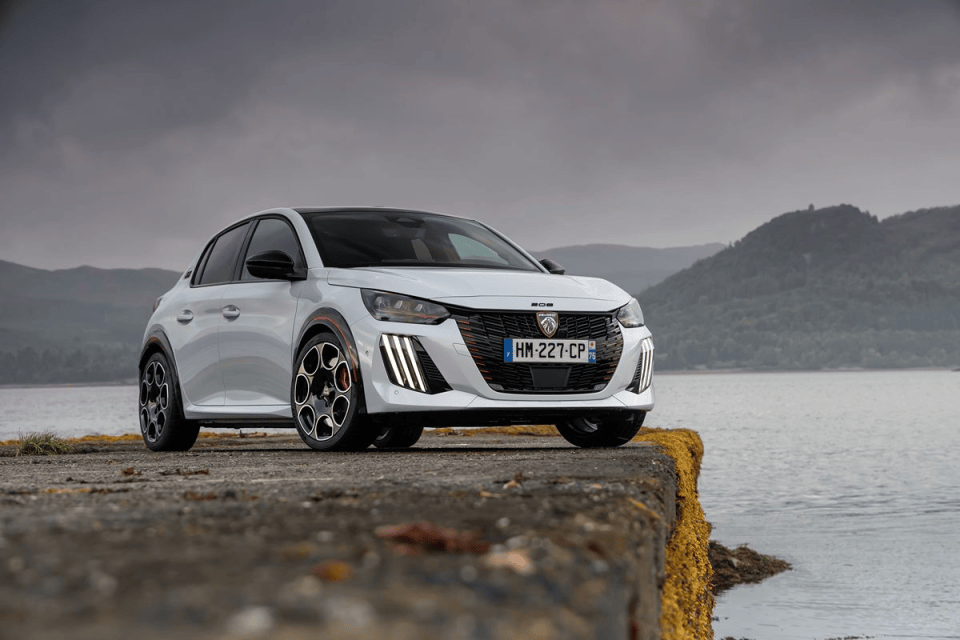
Electric hot hatches are arriving thick and fast in 2026. And unless you double your budget to Ioniq 5 N money, the E-208 GTI might be the best. I’d choose one over an Alpine A290 GTS, Mini Cooper SE or Abarth 600e.
In fact, some of the Peugeot’s strongest competition comes from within the Stellantis Group, in the shape of the Alfa Romeo Junior Veloce and Vauxhall Corsa GSE – both of which used the same 280hp electric drivetrain. We can rule out the Alfa for being an SUV, but the Corsa is a credible contender – and £500 cheaper, too.
Nonetheless, it’s the E-208 I would buy, in no small part due to the allure of that Peugeot GTI badge. Heritage is important, after all.
Tim Pitt writes for Motoring Research